How Much Does It Cost to Hire a Software Developer?
How much does it cost to hire a software developer? The full first-year cost beyond salary — recruiting, benefits, ramp, and mis-hire risk — vs staff...
Hiring a software developer on a $120,000 salary realistically costs $175,000 to $220,000 in the first year — and the salary is the part everyone already knows about. The expensive surprises live in the line items nobody puts in the offer letter: finding the person, the time before they're useful, and the risk that you got it wrong.
What You're Actually Paying For
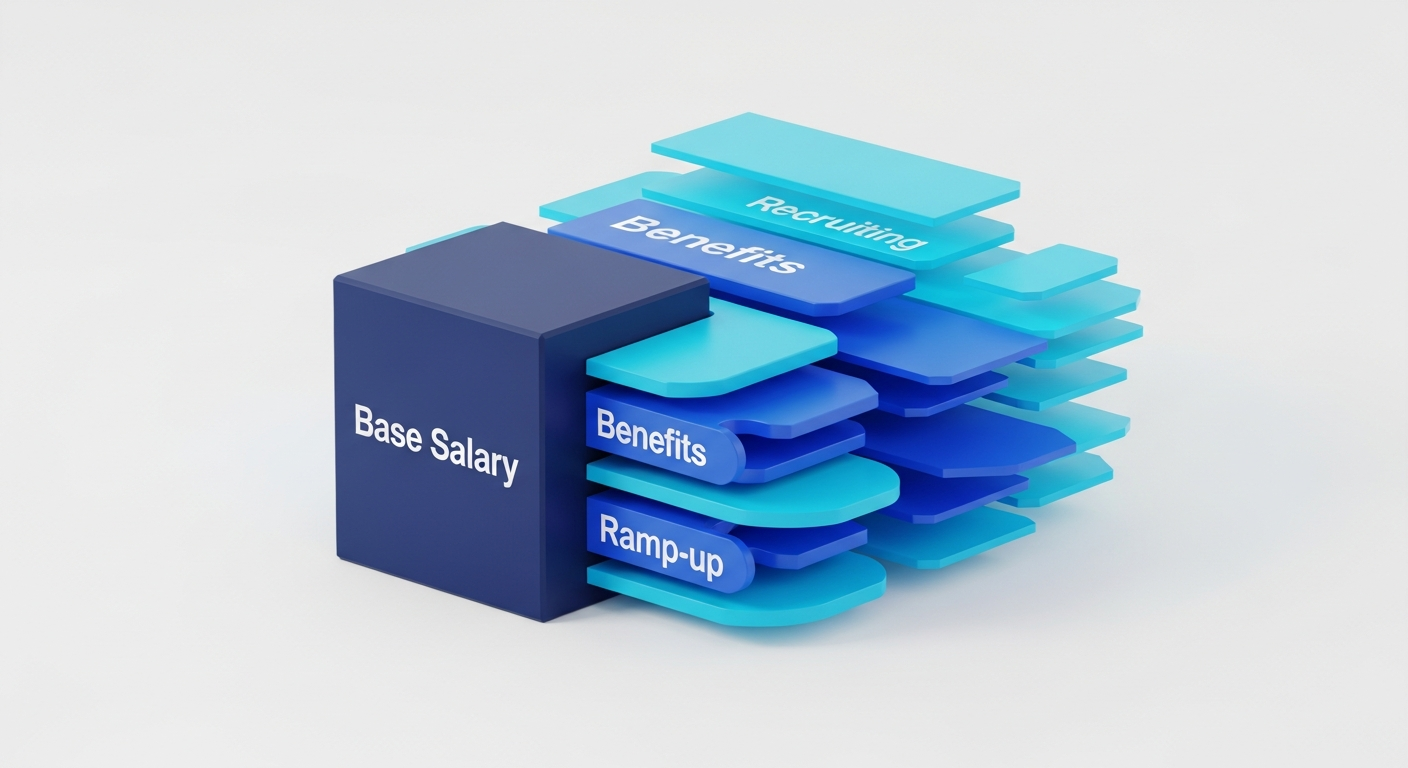
The base salary is the headline. Here's roughly what stacks on top of it for that same $120,000 hire:
- Recruiting: $18,000–$30,000 if you use an agency, or dozens of unbillable hours if you do it in-house
- Benefits and taxes: payroll taxes, health insurance, and retirement add 25 to 40 percent of salary
- Equipment and tools: laptop, software licenses, accounts — a few thousand dollars up front and recurring
- Ramp time: two to four months of full pay before full productivity
- Management overhead: someone has to onboard, mentor, and review them
Add those up and the salary turns out to be roughly two-thirds of the first-year cost. This is a different question from what a developer charges per hour — this is the cost of bringing one onto your payroll and keeping them.
The Hidden Cost: Ramp Time
A developer doesn't ship at full speed on day one. They have to learn your codebase, your conventions, your domain, and who to ask when something breaks. On a mature system, four months to full productivity is normal. You're paying a full salary the whole time. That gap — full cost, partial output — rarely shows up in a hiring spreadsheet, but it's real money.
The Cost Nobody Budgets For: A Mis-Hire
The genuinely painful number is the wrong hire. When a developer doesn't work out at the six-month mark, you've burned half a year of salary, the original recruiting spend, and the project time you can't get back. Then you start over. Industry estimates put the total cost of a failed hire at well over a year of that role's pay. The more senior the role, the worse it stings.
When Hiring Still Makes Sense
None of this means don't hire. A permanent employee is the right call when the work is ongoing and core to your business, when you need someone to grow into ownership of a system, and when you can keep them productive for years. Hiring is an investment that pays off over time — it just costs more, and later, than the salary implies.
The Tradeoff Against Staff Augmentation
The honest comparison comes down to commitment versus flexibility. Hire, and you carry recruiting, benefits, ramp, and mis-hire risk in exchange for a long-term team member. Augment, and you pay a higher hourly rate to skip every one of those costs and get a vetted engineer producing in days. Sweent places engineers as staff augmentation, so for finite or uncertain work you're trading a higher rate for none of the hiring downside — and that's the real decision, not the salary number.
Frequently Asked Questions
For a mid-level US developer on a $120,000 salary, plan on $175,000 to $220,000 in the first year once you add recruiting, benefits, equipment, and the ramp period where they're paid but not yet fully productive. The salary is usually only about two-thirds of the real number.
An external recruiter or agency typically charges 15 to 25 percent of first-year salary, so $18,000 to $30,000 on a $120,000 role. Even hiring in-house isn't free — your team spends dozens of hours sourcing, screening, and interviewing, and that time has a real cost.
Ramp-up usually takes two to four months before a developer is contributing at full speed, and longer on a complex codebase. During that window you're paying full salary for partial output, which is a cost most hiring budgets quietly ignore.
A mis-hire is the expensive one. Between the wasted salary, the rehiring cost, the lost project time, and the cleanup of code that has to be reworked, a failed developer hire commonly runs well over a year of that person's salary by the time you've recovered.
It removes most of the line items. No recruiting fee, no benefits load, no severance risk, and a vetted engineer who's productive in days rather than months. You pay a higher hourly rate, but you skip the sunk costs and the mis-hire exposure entirely.