How Much Do Staffing Agencies Charge? The Markup Explained
How much do staffing agencies charge? How the bill rate, pay rate, and 25–50 percent markup work, plus exactly what that staffing margin actually pays...
Staffing agencies make their money on a markup — the difference between what they pay the worker and what they bill you — and for contract roles that markup usually runs 25 to 50 percent. So a developer paid $60 an hour is commonly billed to a client somewhere around $75 to $90. Understanding what sits inside that gap is the difference between thinking you're being gouged and knowing you're not.
Bill Rate vs Pay Rate
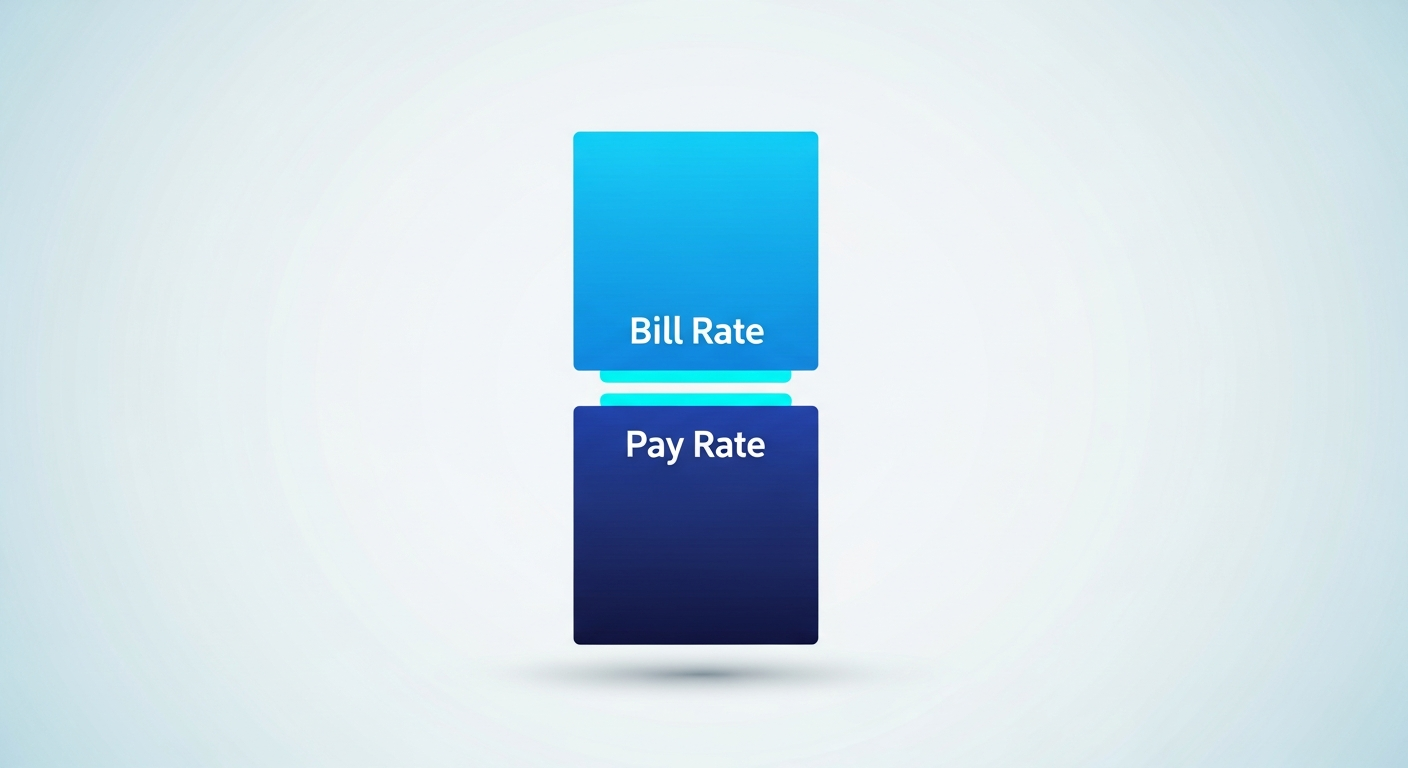
Two numbers run every contract staffing deal. The pay rate is what the worker takes home per hour. The bill rate is what the agency charges you per hour. The markup is the spread between them, expressed as a percentage of the pay rate.
The math is simple once you see it: a $60-an-hour pay rate at a 40 percent markup produces an $84 bill rate. The worker still gets $60. The extra $24 goes to the agency — but most of it isn't profit.
What the Markup Actually Buys
The instinct is to read the entire markup as margin. It isn't. A large share is the unavoidable cost of legally employing the person on the agency's books:
- Employer payroll taxes (Social Security, Medicare, federal and state unemployment)
- Workers' compensation and liability insurance
- Recruiting, screening, and skills vetting
- Benefits, where the agency provides them
- Back-office payroll, invoicing, and compliance
- Bench risk — paying or carrying a worker between assignments
- The agency's actual profit, which is often the smallest slice
On a 40 percent markup, employment taxes and insurance alone can eat 15 to 20 points before the agency keeps a dime. That's why a "lower markup" agency isn't automatically the better deal — someone underpricing the role may be cutting vetting, skipping insurance, or misclassifying the worker.
Where the Markup Lands by Role
Markups aren't uniform. High-volume general or clerical staffing tends to run leaner, in the 25 to 35 percent range, because the agency fills a lot of seats. Specialized technical and IT roles run higher, often 35 to 50 percent, because the recruiting is harder and the talent is scarcer. The harder the role is to fill well, the more the markup reflects the work of finding the right person rather than just processing payroll.
Reading a Staffing Quote Without Getting Burned
The trap is comparing bill rates without seeing the pay rate behind them. A low markup on a low pay rate can mean the agency is fielding a weaker candidate. Ask what the candidate is actually being paid, what the markup covers, and whether insurance and vetting are real. The cheapest bill rate is rarely the best value, and the most expensive isn't automatically a ripoff — the markup is mostly the cost of doing it correctly. Sweent places vetted engineers through state and federal staffing vehicles at transparent rates, so you can see what the work is actually worth.
Frequently Asked Questions
For contract staffing, markups usually land between 25 and 50 percent over the worker's pay rate. Specialized or hard-to-fill technical roles sit at the higher end, while high-volume general staffing sits lower. A markup far above 60 percent is worth questioning unless the role is genuinely scarce.
The pay rate is what the worker earns per hour. The bill rate is what you, the client, pay the agency per hour. The gap between them is the markup, and it covers the agency's costs and profit. So a worker paid $60 an hour at a 40 percent markup is billed to you at $84.
More than profit. It covers employer payroll taxes, unemployment and workers' comp insurance, recruiting and vetting, benefits if offered, the risk of carrying the worker between assignments, back-office payroll, and the agency's margin. A chunk of the markup is just the cost of legally employing someone.
Permanent placement is a one-time fee, not an ongoing markup — typically 15 to 25 percent of the hire's first-year salary, paid once when the candidate is hired. It's a finder's fee for sourcing and vetting, with no recurring component after the placement.