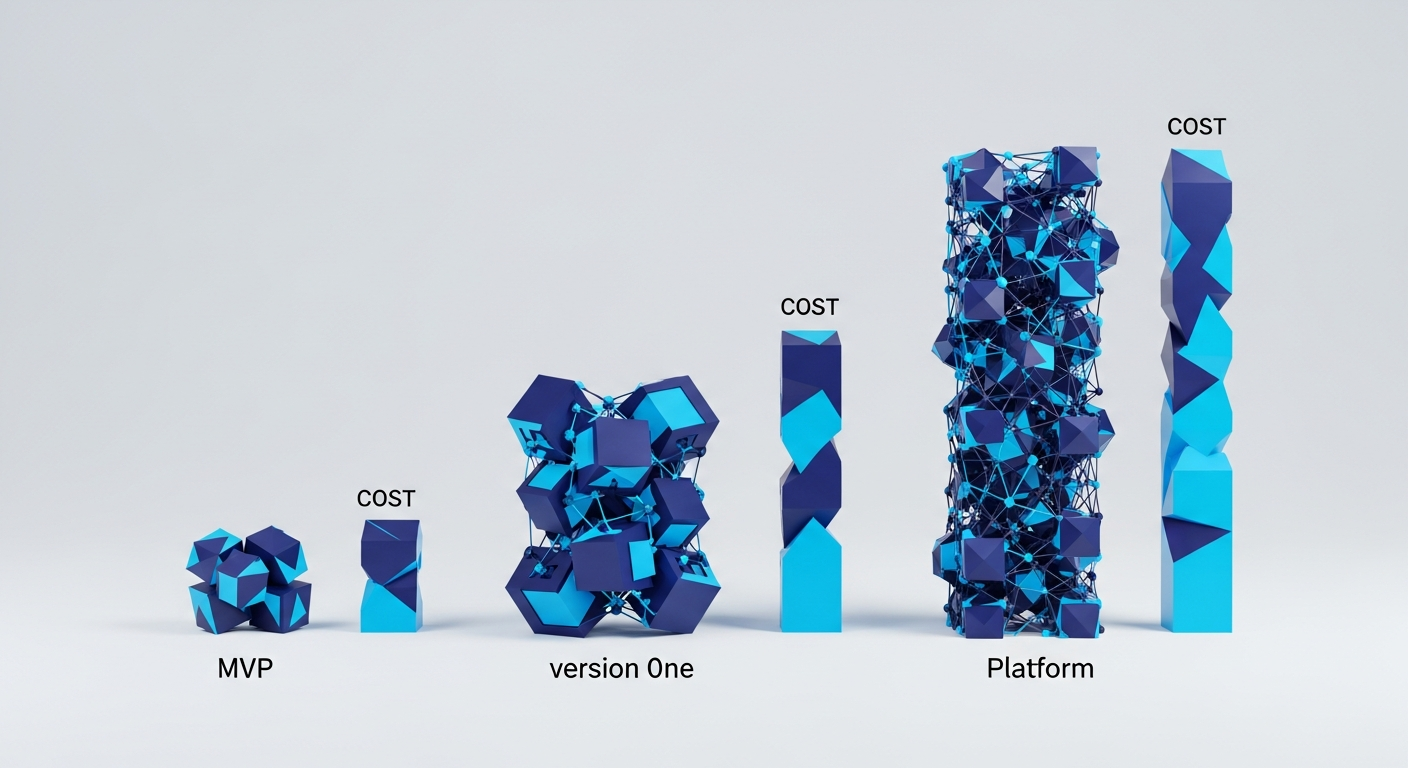
Average Cost of Custom Software Development by Project Size
The average cost of custom software development by project size — real ranges for an MVP, a production v1, and a full platform, with what each phase c...
Ask for the average cost of custom software and you'll get a useless answer, because the figure tracks how big a thing you're building. A scrappy MVP and a multi-team platform are both "custom software," and they're an order of magnitude apart. The honest way to budget is by project size and phase, so here's what each tier actually costs and contains.
The Three Phases by Size
Most custom software falls into one of three brackets, and they build on each other:
| Phase | Typical cost | What you get |
|---|---|---|
| MVP | $25,000–$80,000 | One core workflow, testable with real users |
| Production v1 | $80,000–$250,000 | Hardened, multi-feature, business-ready |
| Platform | $250,000–$1M+ | Multiple systems, user types, integrations, scale |
The jumps between tiers aren't linear because each phase adds whole categories of work, not just more of the same.
MVP: Prove the Idea
An MVP exists to answer one question — do people actually want this? It includes the single most important workflow, just enough interface to be usable, and nothing else. No admin panels you don't need yet, no edge cases for users you don't have. Kept honest, an MVP lands in the $25,000 to $80,000 range. The discipline is in what you leave out; every feature added "to be safe" is money spent on an unvalidated guess.
Production v1: Make It Real
The MVP proved demand. The v1 turns it into something you can run a business on, which is where teams underestimate the cost. The build now has to handle real accounts and permissions, the inputs users will actually throw at it, failures handled gracefully, automated testing, and the unglamorous edge cases the MVP ignored. That hardening commonly costs two to four times the MVP, even though the visible feature set might only grow modestly. You're paying for reliability, not novelty.
Platform: Many Moving Parts
A platform is a different animal. It's not one application but several — multiple user roles, connected services, third-party integrations, and infrastructure designed to scale under load. Each of those multiplies design, development, and testing, and coordinating across them is its own cost. This is the six-figures-and-up territory, and it earns the price only when the scale and complexity are genuinely there.
Phasing Beats Big-Bang
The most expensive mistake is funding a full platform before testing the assumptions underneath it. Build the MVP, put it in front of real users, and let what you learn shape the v1. You'll cut features you were sure you needed and add ones you never imagined, and you'll spend the platform budget on something that's actually been validated. Sweent scopes custom software in phases like these and quotes a fixed price once the scope for the current phase is clear.
Frequently Asked Questions
A minimum viable product — one core workflow, enough polish to test with real users — usually lands between $25,000 and $80,000. The goal is to prove the idea works before spending on everything around it, so anything that doesn't validate the core gets cut from the number.
Often two to four times the MVP. A production v1 adds the accounts, permissions, error handling, testing, and edge cases the MVP skipped. The MVP proves people want it; the v1 makes it something you can actually run a business on, and that hardening is where the extra cost goes.
Because a platform isn't one app — it's several systems, multiple user types, integrations, and infrastructure built to scale. Each of those multiplies the design, build, and testing work. The cost reflects coordination across many moving parts, not just more screens.
Rarely. Building straight to a full platform means betting a large budget on assumptions you haven't tested. Most teams do better starting with an MVP, learning from real use, then funding the v1 and beyond with evidence instead of guesses.