
How to Price Data Analytics Services: A Buyer's Guide
How to price data analytics services: how scoped-project, monthly-retainer, and outcome-based models work, and which pricing structure protects the buyer.
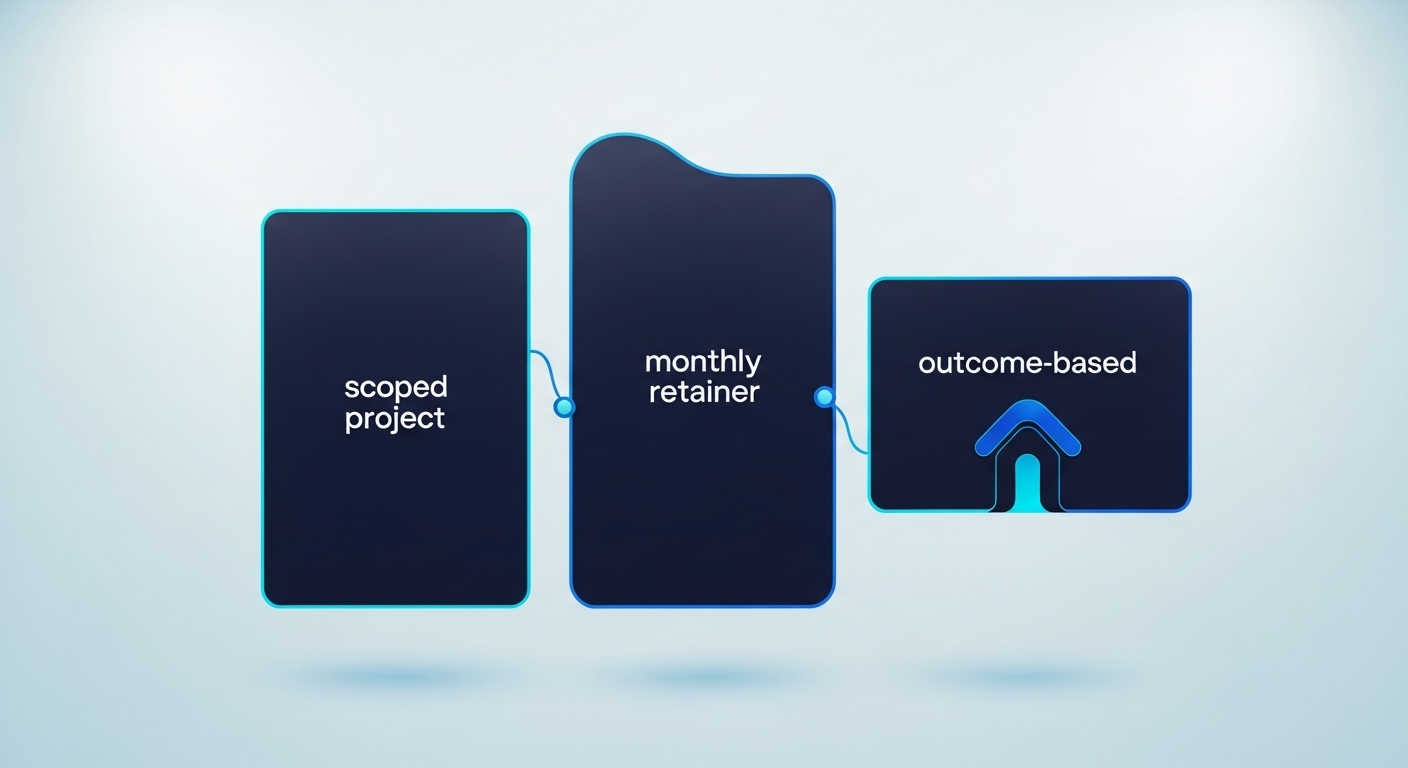
When you're buying data analytics work, the price tag matters less than the pricing structure behind it. The same engagement looks completely different depending on whether it's sold as a fixed-scope project, a monthly retainer, or an outcome-based fee — and which one you pick changes who carries the risk. Here's how each works from your side of the table.
Fixed-Scope Project Pricing
This is a single number for a defined deliverable — a dashboard, a data warehouse, a specific analysis. The appeal for a buyer is certainty: you know the cost before work starts, and the vendor absorbs the risk of overrun.
The model only holds if the scope is genuinely nailed down. A fixed price on a vague request quietly becomes a change-order machine, where every clarification triggers a new charge. Before you accept a fixed quote, make sure the statement of work names the exact dashboards, data sources, and refresh behavior. If it's fuzzy, the fixed price is an illusion.
Monthly Retainer Pricing
A retainer buys a recurring block of analytics capacity — a set number of days or a defined service level each month. It fits work without an end date: new questions keep coming, the data keeps shifting, and you'd rather not renegotiate a quote each time.
The buyer's risk here is paying for reserved time you don't fully use, or watching a vendor coast. Protect yourself by tying the retainer to deliverables or a tracked level of effort, not just availability. A good retainer shows visible output every month. A bad one is a subscription to someone's calendar.
Outcome-Based Pricing
Here the fee links to a result — revenue lifted, hours saved, churn reduced. It sounds like perfect alignment, and occasionally it is. But it only works when three conditions all hold: the outcome is measurable, it's genuinely attributable to the analytics work, and it doesn't depend on whether you act on what the data shows. Analysts can surface the insight; they can't force the org to use it. When any condition fails, outcome pricing turns into an argument over attribution. Treat it as the exception, not the default.
How to Choose the Structure
Match the model to the certainty of the work. Clear deliverable, agreed scope — take the fixed project. Open-ended, evolving need — take the retainer. A rare, cleanly measurable result you fully control the response to — consider outcome pricing, with a tight contract.
What to Ask Before You Sign
Whatever the model, press on a few points: What exactly is in scope, and what triggers a change order? How is progress reported? What happens if data turns out messier than assumed? Who owns the final dashboards and the underlying code? The answers tell you more than the dollar figure. Sweent prices analytics as either a fixed-scope project or a monthly retainer, chosen by whether your need has a finish line.
Frequently Asked Questions
-
What are the main ways analytics work is priced?
Three structures dominate: a fixed price for a scoped project, a monthly retainer for ongoing capacity, and outcome-based pricing tied to a result. Most credible vendors offer the first two; outcome pricing is rarer because the result depends partly on decisions the vendor doesn't control.
-
Which pricing model is safest for the buyer?
A fixed price on a tightly scoped deliverable gives you the most budget certainty, as long as the scope is genuinely clear. The risk shifts to the vendor to deliver within the number. The catch is that fixed pricing only works when both sides actually agree on what's being built.
-
When does a retainer make more sense than a project?
When the work doesn't have a clean finish line. If you'll keep asking new questions and your data keeps changing, a retainer buys steady capacity without renegotiating a quote every time. The thing to watch is that you're getting real output each month, not just paying to reserve someone.
-
Is outcome-based analytics pricing worth it?
Sometimes, but read the fine print. Tying a fee to a metric only works when the metric is measurable, attributable to the analytics work, and not dependent on whether you act on the findings. If any of those break down, the model creates disputes rather than alignment.
Related Articles
-
Top Data Analytics Solutions: A Build-vs-Buy Guide
The data analytics market is crowded and confusing. Here's the real landscape, when to buy a platform versus build your own, and where a partner actually earns their fee.
-
How Much Do Data Analytics Services Cost?
Analytics work ranges from a few thousand for a single dashboard to ongoing five-figure retainers. Here's what the numbers look like and what drives them.
-

Data Analytics Companies in Daytona Beach, Florida
How to pick a data analytics partner in Daytona Beach — the pipeline-to-dashboard chain that actually matters, and how to tell a real shop from a slide deck.